
9 Years of Digital Marketing: What Changed, What Didn’t and What Comes Next
When I was a baby business owner in 2017, I was excited if a client cared about their Google analytics - and better yet - asked me to help them decipher what the data was telling them and how it would help us inform their marketing strategy.
Now… nine years later, I’m a pseudo therapist trying to talk down a panicked marketing manager who is trying to stay ahead of AI. (You just can’t do it, my man, and that’s ok!).
The digital world is changing faster than any of us could have predicted, not to mention there was the whole COVID-19 pandemic and that alone fundamentally changed how many businesses approached their marketing.
Key Takeaways: How Digital Marketing Has Changed Since 2017
Digital marketing channels haven’t disappeared, but the rules have changed. Social media, email and search still play important roles, but marketers need to evaluate their effectiveness differently in 2026.
Social media is increasingly a discovery and credibility channel. Instead of focusing only on impressions and follower counts, look at profile activity, website clicks and signs that people want to learn more about your brand.
Email engagement matters more than email opens. Privacy features and automated opens have made open rates less reliable, making click-through rates and subsequent actions stronger indicators of interest.
SEO is evolving from rankings to visibility. With AI-powered search and zero-click experiences, brands need useful content that can surface wherever buyers are looking for answers—not just on page one of Google.
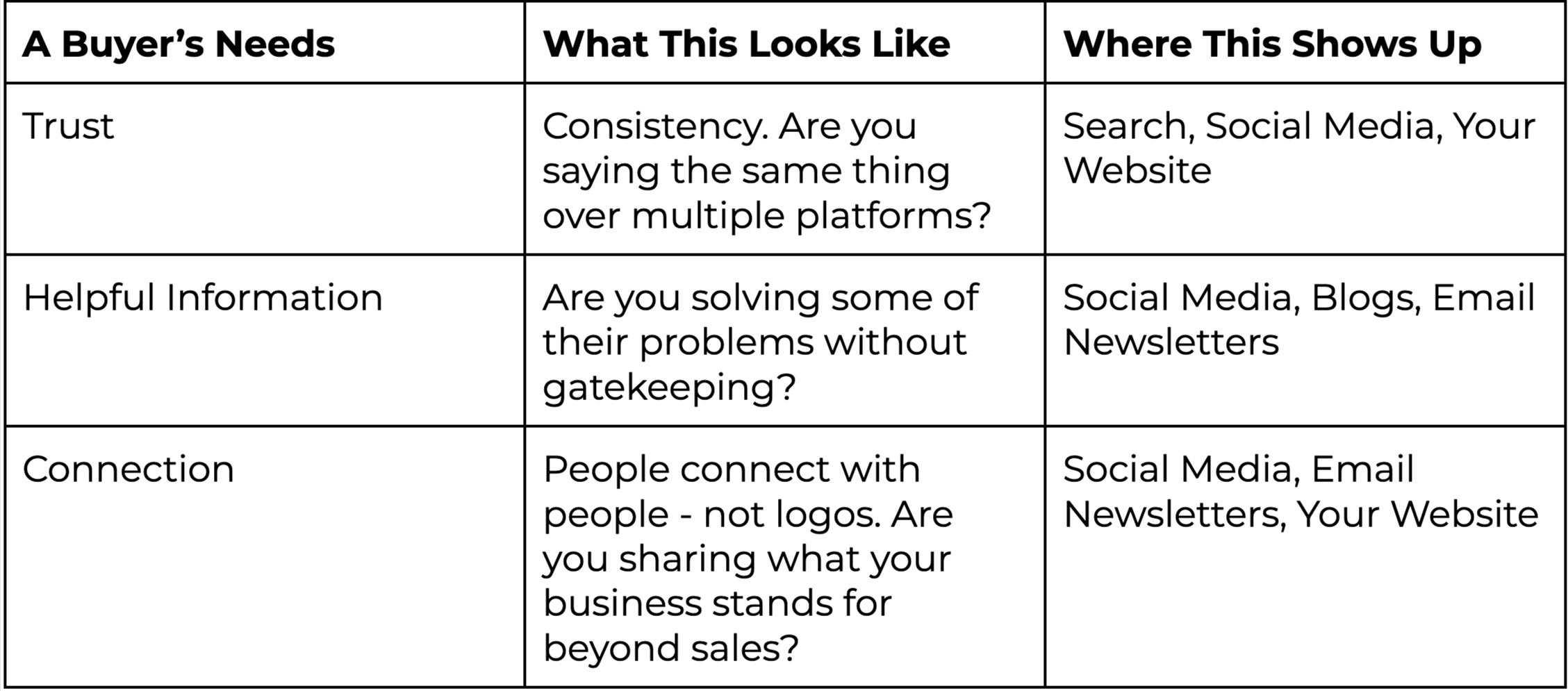
B2B buyers are researching across multiple platforms before contacting companies. Consistency across search, social media, email and your website helps build familiarity and trust before a buyer ever speaks with your team.
The fundamental job of marketing hasn’t changed. Buyers are still looking for trustworthy answers to their problems. The brands that consistently provide helpful, credible and human content have the best opportunity to earn their attention.
It’s not just about ads and billboards and mailers (nobody was driving or even touching their mail in 2020). It’s about showing up for people where they spend most of their time (yes, even in 2026 that means, online).
And not just showing up with a “Hey, give me your money!” but showing up in a way that is helpful, instructional or just plain fun.
In light of our nine-year anniversary, I’m taking a look at where things have changed - and where they’ve stayed the same in the digital marketing world.
How Digital Marketing Has Changed From 2017 to 2026
Same channels, different rules
In 2017, Next Page was doing a lot more than we are now. And we’ve niched for a reason.
B2B marketing has evolved with the times and what was once a relatively helpful too in 2017 (Hi, Facebook) is less so in 2026.
That’s mostly because of what buyers are doing. They are acting differently and thinking differently in 2026 and therefore the market has changed.
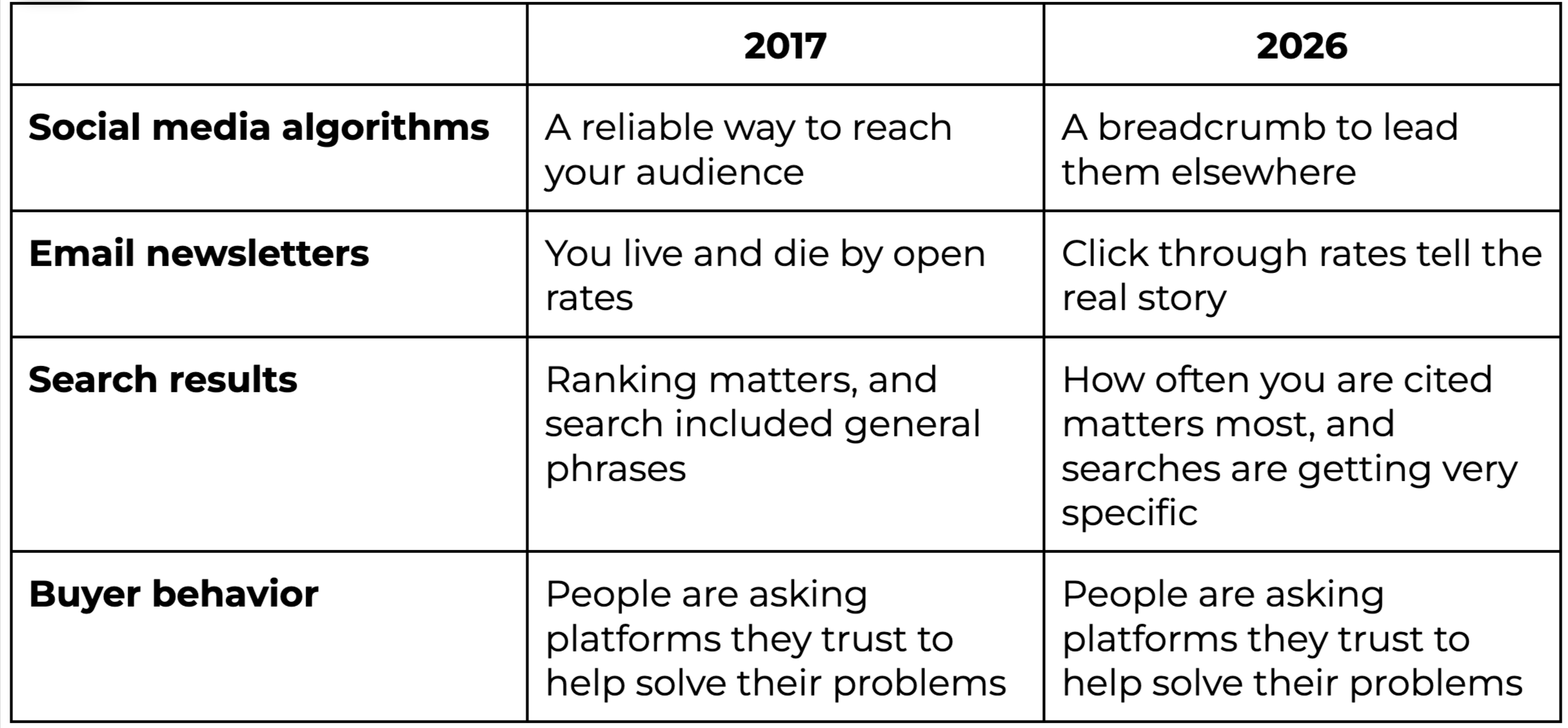
Let’s take a look at the biggest players in nearly any B2B marketing strategy: Social media, Email newsletters and Search.
How Social Media Marketing Has Changed in 2026
From distribution channel to profile power
Organic reach was a thing in 2017. You could confidently post on Facebook or Instagram and expect that your post would reach many of your followers.
Now, you’re competing with ads, AI slop, and even if your content reaches the right audience, there’s a chance they don’t trust what you’re saying or showing them. Social media requires more consistent posting than we’ve seen in the past. Where it might take 3-6 months to see consistent impressions, now, it’s closer to 9-12 months.
In 2026, we are less focused on how many impressions a post is getting. Now, our team is asking questions like:
Did this post translate to activity on the page?
Did people stay on the page, follow or click around?
Did the page drive people to the website?
The posts are less about getting people to take an important action. It’s more so about driving people to be curious and learn more about the brand.
Bottom Line:
2017: Publishing could reliably translate into organic reach, making follower growth and distribution central to a marketing strategy.
2026: Algorithms increasingly change, making access to an audience less predictable. Look for other signs of an engaged audience: profile visits and link clicks.
Email Marketing in 2026: Why Click-Through Rates Matter More Than Open Rates
Don’t fear mass messaging
In the spring of 2020, did you inbox light up with names of businesses you hadn’t thought about in years?
That’s because many small businesses panicked when they couldn’t reach their customers - especially if they were brick and mortar - so they dusted off the old email list they had been accumulating for years.
It apparently took a pandemic for them to take email newsletters seriously.
Whether you are B2C or B2B, email newsletters are helpful to succinctly share the information your audience cares about and who could have genuinely missed it while they were scrolling their feeds.
But the metric for success has changed.
In 2017, an open rate was a good enough indicator that someone was interested in your content. Now, with more advanced spam filters and privacy settings, your email could be flagged as “opened” on your end, when in reality, it was automatically moved to a spam folder on the user’s end.
The needle has moved towards CTR (click through rates). Just like with a social media post, simply grazing the content isn’t a reliable indicator of anything. If the person is taking action once they open the email, it’s a signal that they are more interested in your brand than the average user.
Bottom Line:
2017: If someone opened your email = success!
2026: When it’s difficult to reach your ideal audience on social media, an email newsletter provides a more personalized touch point - as long as the user clicks through the links provided.
SEO in 2026: Why Search Visibility Matters More Than Rankings
Rankings don’t matter anymore
Ah, SEO. People keep saying you’re dead, but we know you’re not!
The basics of SEO (or Search Engine Optimization) is as true today as it was in 2017: People use search engines to learn about solutions they need, or brands they may want to work with.
Now, however, there are more options for search (it’s not just Bing and Google anymore), and these search engines are talking back.
Rightfully so, businesses want to be part of the conversation, so how do they reliably accomplish this? They write more content.
That’s where the good ole’ blog comes in. What a blog did for your website in 2017, it can still do - and then some - in 2026.
The content on your website allows these search engines to crawl and understand who you are, what you do, and how you can help. It also has resulted in what experts are calling the “zero click economy.” This means that many users are getting the answers that they need within the AI or search platform itself, and so they may not ever click into your website.
However, when and if they do - you know that they are extremely interested in your services or product. SEO has moved users from browsers to answer-seekers. And if your content shows up consistently in their queries - you’ve done your job.
Bottom Line:
2017: Ranking high on page one was the signal that your brand was being seen.
2026: It doesn’t matter where you rank on a search platform as long as your brand is consistently visible in the conversations that matter to your customers.
How B2B Buyer Behavior Has Changed in 2026
Buyers are still looking for answers
If there is one comforting thought in all that has changed in the digital world, it’s that people are still fundamentally turning online to do the same thing: find answers to their problems.
Except they’re not turning to just one platform (or two) now. They’re looking across multiple different platforms and gathering a lot of information before they move forward with a decision. In fact, 94% build and rank a shortlist before contacting a brand. So what are people looking for when they search? The same thing they’ve always looked for. And they’re looking for it in relatively some of the same places.
What Hasn’t Changed About Digital Marketing
The tools changed. The job didn’t.
Nine years in digital marketing has taught me that there will always be a new platform, algorithm, metric or technology that makes marketers wonder if everything they know is suddenly obsolete.
Usually, it isn’t.
The way people find information has changed. The way we measure their interest has changed. And the number of places where your brand needs to show up has definitely changed. But the reason people are searching in the first place hasn’t.
That’s why the fundamentals still matter.
And I don’t mean the fundamentals of marketing (or, at least not totally). I also mean the fundamentals of building connections with real people. You can still be a brand that people trust even if their only connection with you at first is online. Be consistent. Be helpful. Be real. And the rest will come.
—
Stay as up to date as possible in the world of digital marketing with news and tips on our LinkedIn page. Click here to follow us!